
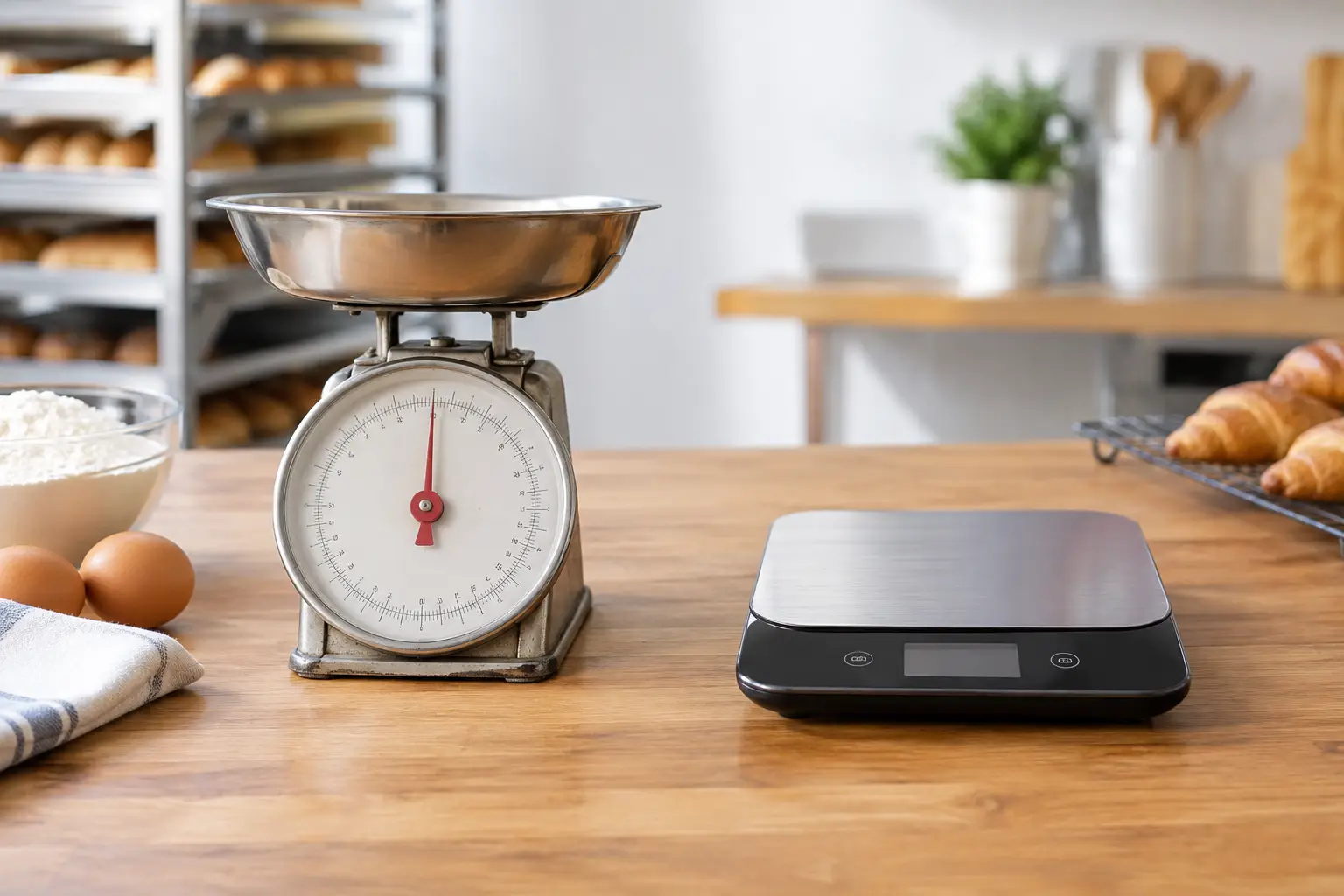
A queue forming at the counter is the wrong time to discover your scale is drifting, freezing or refusing to print a label. A planned bakery scale replacement protects more than weighing accuracy. It protects customer trust, pricing consistency, staff confidence and the pace of your trade.
For bakeries, patisseries, cafes and food retailers selling by weight, a scale is part of the transaction process. It needs to be accurate, suitable for the job and dependable through busy morning service. Knowing when to repair a scale and when to replace it helps avoid costly downtime and rushed purchasing decisions.
When does a bakery scale need replacing?
Age alone is not a reason to retire working equipment. A well-maintained commercial scale can provide many years of dependable service. The better question is whether it still performs accurately, complies with your selling method and supports the way your team works.
Repeated faults are a clear warning sign. If a scale regularly fails to power on, loses its display, gives unstable readings or needs resetting during service, the disruption can quickly outweigh the cost of replacement. A single fault may be repairable. Several faults over a short period often indicate worn components or an ageing unit approaching the end of its practical life.
Inconsistent weights deserve immediate attention. Flour, dough, fillings and prepared products all rely on repeatable portions. Even small variances can affect product quality, food cost and margins across hundreds of transactions. Where products are sold by weight, inaccurate readings can also create a trade measurement issue.
Replacement should also be considered when the scale no longer fits your operation. A growing bakery may need a larger platform, a higher capacity, a more readable customer display or faster label printing. A compact bench scale that suited a small counter may not suit a busy production area or a multi-product deli display.
Repair or bakery scale replacement?
The right answer depends on the fault, the scale’s condition and how critical it is to daily trade. A professional assessment is generally the best starting point, particularly when a unit has otherwise been reliable.
Repair is often sensible when the issue is isolated. A damaged power supply, worn key pad, broken display, damaged load cell cable or calibration problem may be resolved at a reasonable cost. If the scale remains suitable, parts are available and it can be returned to reliable operation promptly, repair can deliver good value.
Replacement is usually the stronger option when repairs are becoming frequent, key parts are no longer available or the cost of repair is a significant portion of a comparable new unit. It may also be the better choice where a scale cannot be appropriately verified for trade use, lacks the capacity you now need or does not integrate with current workflows.
Downtime matters as much as the repair invoice. If your counter scale fails on a Saturday morning, staff may be forced to estimate weights, move customers to another till or stop selling particular products. For a business that relies on fast transactions, a dependable replacement can be less expensive than continued interruptions.
Trade-approved scales and selling by weight
If you sell goods to customers by weight, the scale used for that transaction must generally be trade approved and verified for use in Australia. This applies whether you are weighing bread rolls, sliced meats, confectionery, bulk ingredients or prepared food for a customer.
A kitchen scale used only to check recipe portions in a back-of-house production area is different. It may not need trade approval if its reading is never used to determine the price charged to a customer. However, once the weight displayed affects what a customer pays, the equipment and its verification status matter.
It is easy to buy a low-cost scale online that looks suitable but is not approved for trade. That can create problems at inspection time and may leave you replacing the equipment sooner than expected. Before choosing a new scale, confirm how it will be used, the required capacity and resolution, and whether you need a customer-facing display or label-printing capability.
Trade equipment also needs correct installation and ongoing attention. An accurate scale can give poor readings if it sits on an unstable bench, is exposed to vibration, has debris under its platform or is moved without being checked. Regular cleaning, sensible placement and prompt servicing all help protect accuracy.
Choose a scale for the actual workload
The best replacement is not always the most feature-rich model. It is the model that handles your products, volume and available counter space without adding unnecessary complexity.
Counter and retail scales
For front-counter sales, consider the platform size, weight capacity and display visibility first. Staff need to see the reading quickly, while customers should be able to view the weight and price where required. A dual-display retail scale can support transparency and reduce disputes during busy service.
If you sell several products by weight, programmable product keys can make transactions faster and reduce manual entry errors. In a high-volume bakery or deli setting, that time saving can be meaningful across a full day.
Label-printing scales
A label-printing scale can be a practical fit for businesses pre-packing pastries, cakes, sandwiches, salads or deli items. It can print weight, price, product information and barcode details, depending on the system and configuration.
This approach works best when the scale, labels and point-of-sale system are set up around your actual process. Consider the label size, the number of products, staff access and whether pricing changes are managed centrally. A capable scale with a poorly configured product file can still slow your team down.
Production and portion-control scales
Back-of-house scales need to be durable, easy to clean and suitable for the weights being handled. A small, highly precise scale may suit yeast or additives, while a larger platform scale may be needed for dough tubs and bulk ingredients. In some bakeries, two scales are more useful than one compromise unit.
Choose enough capacity for your heaviest normal task, rather than the average task. At the same time, avoid selecting an unnecessarily large capacity scale if fine portion accuracy is the priority. Capacity and readability involve a trade-off, so the scale should be matched to the product and process.
Plan the changeover before the old scale fails
A replacement project is easier when it is planned around a quieter period rather than an equipment emergency. Start by recording the make, model and purpose of the current scale, then note the issues your staff experience. This creates a clear brief for selecting the replacement.
Think through the practical details early. Measure the available bench space, confirm power access and check whether the scale needs to connect to a POS system, cash drawer, printer or network. If labels are involved, make sure you have the correct consumables and a process for maintaining product and price information.
Staff training should be part of the installation, not an afterthought. Even a straightforward scale can cause delays if team members do not know how to zero the platform, select products, change label rolls or recognise an error message. A short handover helps staff start correctly and reduces avoidable support calls.
Keep a backup plan as well. For some businesses, retaining a serviceable spare scale or having access to equipment hire can prevent a small fault from becoming a lost trading day. This is particularly worthwhile for market operators, seasonal businesses and venues with a single critical point of sale.
Service support is part of the purchase decision
Scales work hard in bakery environments. Flour dust, moisture, knocks, heat and constant cleaning all take their toll. Local servicing support can be as valuable as the specification printed on the box.
Ask who will install the scale, verify it where required, configure products or labels, and respond if something stops working. It is also worth asking about calibration, workshop repairs, on-site support and access to replacement equipment. The lowest purchase price may not represent the lowest operating cost if help is difficult to obtain when you need it.
For Southeast Queensland businesses, EBE can assess existing weighing equipment, recommend a fit-for-purpose replacement and provide installation, trade scale verification and ongoing technical support. The aim is to give your team equipment that works properly in the real conditions of your business.
A scale rarely fails at a convenient time. Replacing it on your terms gives you the opportunity to improve accuracy, speed up service and put dependable support in place before the next busy morning.







Leave A Comment
You must be logged in to post a comment.