
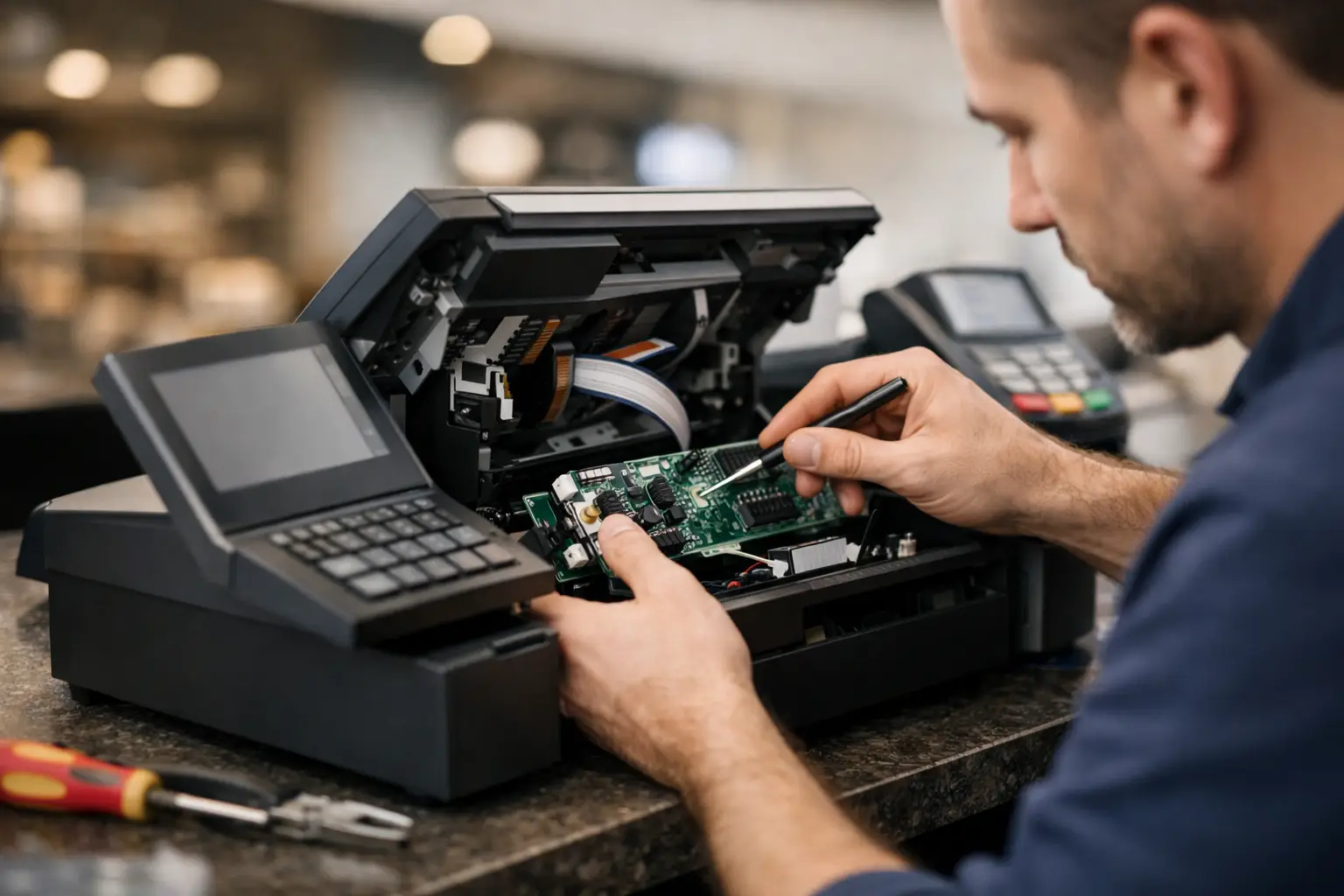
When a cash register stops working in the middle of a lunch rush or weekend trade, the problem is never just the machine. It slows staff down, holds up customers, creates pricing errors and puts pressure on the whole front counter. That is why cash register repairs need to be handled quickly, properly and with a clear understanding of how your business actually operates.
For many retail, hospitality and food service businesses, the register is still a critical part of daily trade, even when it sits inside a broader point-of-sale setup. A fault might look minor at first – a drawer not opening, keys sticking, a display cutting out, a printer feeding poorly – but small issues rarely stay small when a venue is busy. The real goal is not just getting the unit to power back on. It is getting the checkout reliable again so your team can serve customers without second-guessing the equipment.
What cash register repairs usually involve
A proper repair starts with diagnosis, not guesswork. Registers can fail for a range of reasons, and the symptoms do not always point neatly to the actual cause. A machine that freezes during sales could have a failing power supply, internal board issue, corrupted programming, worn keypad or a peripheral fault affecting communication. Replacing the wrong part wastes time and money.
In practical terms, cash register repairs often involve testing the power system, checking operator displays, inspecting keyboards and membrane switches, assessing receipt printers, testing drawers and cable connections, reviewing programmed functions and confirming communication with attached devices. If the register is connected to scanners, EFTPOS integration, kitchen printers or scales, those relationships matter as well. Sometimes the register is not the whole problem. It is one part of a larger setup that has developed a fault.
This is why experienced technicians matter. A repairer who understands transaction equipment in real-world business environments can often identify patterns quickly. Heat, grease, dust, moisture, worn connectors and simple age all affect performance, especially in cafes, takeaway shops and busy counters where equipment works hard every day.
Common faults and what they can mean
Some faults are straightforward. A faded operator display may point to a display issue or power problem. A receipt printer jam might be caused by worn rollers, poor-quality consumables or a sensor fault. A cash drawer that will not open could be the drawer itself, the trigger circuit or a programming setting.
Other faults are more intermittent and more frustrating. The register may reboot at random, lose programmed items, stop communicating with peripherals or lock up only during peak trade. These are the jobs where careful fault-finding saves a lot of disruption. Intermittent problems can be caused by unstable power, damaged internal components, loose ports or software corruption. If the machine only gets a quick reset and goes back into service, the fault often returns at the worst possible time.
Older equipment adds another layer. Many businesses keep older registers because the system is familiar, reliable enough and already paid for. That can be a sensible decision, but repairs become more dependent on parts availability and technician knowledge. In some cases, a repair is still the best value. In others, repeated breakdowns start costing more in labour, downtime and lost trade than a replacement would.
Repair or replace? It depends on the fault and the role of the machine
There is no single rule here. If a register has a clear, isolated fault and the rest of the system is sound, repair is often the practical choice. A quality repair can extend the life of the unit and avoid the cost and disruption of retraining staff or changing workflows.
If the machine has recurring faults, limited parts support or no longer fits your trading needs, replacement may be the better long-term option. The decision should account for more than the repair invoice. You also need to think about how critical that register is, how often it is used, whether the fault affects compliance or transaction accuracy, and how much downtime your business can realistically absorb.
For example, a small seasonal operator might tolerate a slower workaround for a short period. A busy cafe or supermarket-style environment usually cannot. When customers are queued at the counter, every extra minute matters.
Why fast local support makes a difference
For Southeast Queensland businesses, speed matters almost as much as technical skill. Sending equipment away for assessment may be workable for non-critical items, but it is far less practical when your front counter depends on that machine every day. Local workshop and on-site support can make the difference between a manageable interruption and a full day of lost sales.
There is also value in working with a technician who understands your full setup rather than only the faulty register in isolation. If your checkout includes printers, scanners, customer displays, scales or networked POS hardware, the repair process is usually faster when one provider can assess how those pieces connect. It reduces finger-pointing and gives you a clearer answer on what failed, why it happened and what should be done next.
That service-first approach is especially important for businesses that trade early, late or across weekends. Problems do not politely wait for a quiet weekday morning. Responsive support helps protect revenue and gives staff confidence that someone will take responsibility for getting the system back on track.
How to reduce the need for urgent cash register repairs
Not every fault can be prevented, but many can be reduced with sensible maintenance and good operating habits. Registers often fail earlier because of environmental stress and lack of attention to smaller warning signs. Sticky keys, slow printing, inconsistent drawer operation and flickering displays are worth checking before they become breakdowns.
Cleaning matters, but it needs to be done correctly. Food debris, dust and residue can affect keypads, sensors and vents. At the same time, harsh chemicals and too much moisture can create new problems. Staff should know the basic do and do not rules for cleaning transaction equipment.
Power protection is another common issue. Voltage fluctuations, overloaded boards and poor power quality can shorten equipment life. If a register experiences random resets or recurring faults, the power environment should be part of the investigation. Likewise, cheap paper rolls and unsuitable consumables can create printer problems that look like mechanical failure when they are really caused by low-grade inputs.
Routine servicing also has a place, especially for businesses that rely heavily on older hardware. A check before peak trading periods can catch worn parts, damaged cables and configuration issues early. It is easier to schedule maintenance than to manage a breakdown on your busiest day.
Choosing a repair partner for business-critical equipment
Not all repair services are set up for commercial urgency. If your register is central to daily operations, you need more than a generic electronics repair bench. You need a provider who understands transaction hardware, can work on-site when required, has access to suitable parts, and can tell you honestly whether repair is worthwhile.
Clear communication matters just as much as technical ability. Business owners and managers need to know what has failed, how long the repair is likely to take, whether a temporary workaround is available and if the same fault is likely to return. Straight answers help you make better decisions.
It also helps if your repair partner can support the wider system. A register rarely works alone. When one team can assist with POS equipment, peripherals, scales, networking, consumables and ongoing support, you spend less time coordinating multiple suppliers and more time running the business. That is one reason many local operators work with businesses such as Electronic Business Equipment – the support does not end once the machine is sold.
The real value of getting repairs done properly
A quick fix is not always a good fix. If the immediate symptom is patched but the underlying cause remains, the register may fail again under load, and usually at the least convenient moment. Proper repairs protect more than the hardware. They protect workflow, customer experience and staff confidence.
When your team trusts the equipment, transactions are faster, mistakes are reduced and service feels smoother for everyone at the counter. That is the practical value of a good repair job. It is not about keeping an old machine alive at all costs. It is about making sure the tools your business depends on are reliable enough to keep trading without unnecessary interruptions.
If your register is showing signs of trouble, the best time to act is before it becomes a full stop at the counter. Small faults have a habit of turning into expensive ones, while early attention usually gives you more options and less downtime.













Leave A Comment
You must be logged in to post a comment.